How to Turn One Standard Into Reteach and Extension Practice Worksheets

Turn one standard into two useful worksheets
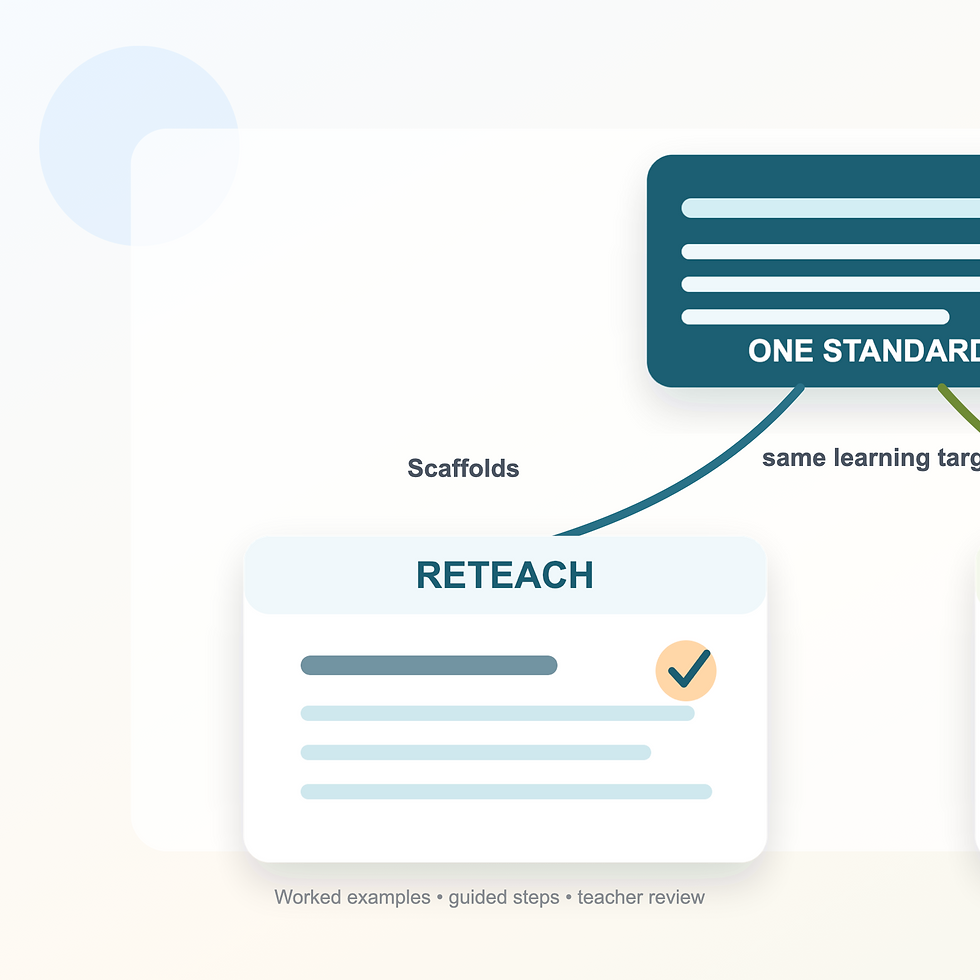
A strong standards-based worksheet pair does two jobs at once: it helps students who need reteaching rebuild the target skill, and it gives students who are ready for more a meaningful extension of the same idea. Start with the standard, name the exact skill students missed or mastered, then create two connected practice paths: one with scaffolds, models, and guided steps; one with transfer, explanation, or multi-step challenge. The goal is not “easy and hard” worksheets. The goal is aligned practice that keeps the class working toward the same learning target at different levels of support.
Why paired reteach and extension worksheets work
In a mixed-readiness classroom, the hardest part is often not knowing what to give students after you check for understanding. A single exit ticket can reveal three groups:
Students who are not yet secure with the prerequisite skill
Students who understand the day’s target with support
Students who are ready to apply the target in a new context
A paired worksheet system helps you respond without building a completely separate lesson for every group. The reteach version stays close to the original learning target and removes unnecessary complexity. The extension version keeps the same standard at the center but asks students to explain, compare, justify, create, or apply.
For example, if the standard is about multiplying whole numbers, the reteach worksheet might include arrays, sentence frames, and worked examples. The extension worksheet might ask students to compare strategies, solve a multi-step word problem, and write their own multiplication situation.
Step 1: Start with the standard, then narrow the skill
Many standards include more than one classroom skill. Before generating worksheets, rewrite the standard as a student-facing target.
Example standard focus:
Standard language: Interpret products of whole numbers. This example is based on the Common Core State Standards multiplication standard for Grade 3.
Student-facing target: I can show multiplication as equal groups, arrays, and equations.
Reteach need: Students confuse the number of groups with the number in each group.
Extension opportunity: Students can represent the same multiplication equation in more than one way and explain which model fits a situation.
That narrowing step matters. If you only paste a broad standard and ask for a worksheet, the practice may be too scattered. A clearer prompt produces a more teachable resource.
A useful prompt might be:
“Create two worksheets from this standard: ‘I can show multiplication as equal groups, arrays, and equations.’ Version A should reteach students who confuse groups and items in each group. Include a worked example, visual models, guided practice, and 6 independent problems. Version B should extend students who already understand the skill. Include strategy comparison, one multi-step word problem, and one create-your-own problem.”
Step 2: Build the reteach worksheet around the mistake
A reteach worksheet should not simply include fewer problems. It should address the actual misconception.
If students missed an exit ticket, look for the pattern:
Did they misread the question?
Did they use the wrong operation?
Did they skip a step?
Did they confuse vocabulary?
Did they know the process but fail to explain it?
Did they understand with numbers but not in a word problem?
Then design the reteach worksheet around that pattern.
For a 5th-grade fraction standard, a reteach worksheet might include:
A short vocabulary box: numerator, denominator, unlike denominators
A worked example with each step labeled
A “spot the mistake” problem using a common error
Two guided problems with blanks and hints
Four independent problems
One reflection prompt: “What step should you check before adding fractions?”
That structure gives students a path back into the standard rather than another page of unsupported practice.
Step 3: Make extension practice more than extra problems
Extension work should not feel like punishment for finishing early. It should deepen the same standard.
Good extension tasks often ask students to:
Explain why a method works
Compare two strategies
Apply the standard in a new context
Create a problem with specific constraints
Analyze an incorrect solution
Connect the skill to a graph, table, passage, diagram, or real-world scenario
For a middle school ratio standard, a reteach worksheet might use tables and double number lines to rebuild the idea of equivalent ratios. The extension worksheet might ask students to compare two better-buy options, write a ratio rule, and explain why two ratios are or are not equivalent.
Both worksheets stay aligned to the same standard. They just ask for different levels of independence and transfer.
Step 4: Use a simple worksheet pair structure
Here is a practical structure teachers can reuse across grade levels and subjects.
Part
Reteach worksheet
Extension worksheet
Opening
Restate the learning target in simple language
Restate the learning target as a challenge question
Model
Include one worked example or annotated sample
Include a non-example, comparison, or strategy choice
Practice
Use guided steps, hints, visuals, or sentence frames
Use multi-step, open-response, or application problems
Check
End with 2–3 independent target-skill questions
End with explanation, justification, or creation
• Teacher use
Small group, intervention, homework repair, next-day warm-up
Early finishers, enrichment group, partner challenge, station work
This keeps the two resources related. Students are not sent to completely different content; they are working from the same standard with different support.
Step 5: Add visual supports where they actually help
Visuals should clarify the standard, not decorate the page. For reteach worksheets, visuals might include number lines, labeled diagrams, graphic organizers, sentence frames, maps, tables, or step boxes. For extension worksheets, visuals can become part of the thinking: students may interpret a chart, complete a model, label evidence, or design a diagram of their own.
If you are using Worksheets.ai to draft the worksheet pair, ask for the visual features directly:
“Create a reteach version with a labeled model, st
ep-by-step boxes, and a short vocabulary section. Create an extension version with a comparison table, one open-ended challenge, and space for students to explain their reasoning.”
For teachers planning beyond a single worksheet, TeachShare can help turn standards, curriculum maps, pacing guides, PDFs, or existing materials into visual, editable classroom resources that teachers can revise, differentiate, and align across lessons or units.
Step 6: Review both worksheets before using them
AI-assisted worksheet drafting can save time, but teacher review is still essential. Before assigning the worksheets, check the standard alignment, directions, examples, reading level, answer expectations, and fit for your students.
Use this quick review checklist:
The worksheet names the same learning target on both versions.
The reteach version addresses a specific misconception.
The reteach version includes at least one model or worked example.
The extension version requires deeper thinking, not just more items.
Both versions use age-appropriate language and directions.
The difficulty increases gradually.
There is enough white space for student work.
The final question gives the teacher useful evidence of understanding.
You can explain why each item belongs on the worksheet.
Classroom example: 4th-grade math
Learning target: I can compare fractions using models and reasoning.
Reteach worksheet:
Review: What the numerator and denominator tell us
Model: Compare 1/3 and 1/4 using same-size rectangles
Guided practice: Shade and compare two fraction pairs
Error analysis: A student says 1/8 is greater than 1/6 because 8 is greater than 6. Explain the mistake.
Independent practice: Compare four fraction pairs
Exit question: How can a model help you compare fractions?
Extension worksheet:
Challenge: Compare fractions without drawing every model
Strategy comparison: Use benchmarks, common denominators, or visual reasoning
Multi-step problem: Choose the better recipe amount and justify
Create-your-own: Write two fractions that are close together and explain how to compare them
Reflection: Which strategy was most efficient and why?
This pair supports the same standard. One worksheet rebuilds the concept. The other pushes students to select and justify strategies.
Classroom example: 7th-grade reading
Learning target: I can identify a theme and support it with text evidence.
Reteach worksheet:
Review: Difference between topic and theme
Model: A short paragraph with an annotated theme statement
Guided practice: Choose which statement is a theme and explain why
Evidence box: Students copy one sentence that supports the theme
Sentence frame: “One theme is ___ because the character ___.”
Independent practice: Write a theme statement for a short passage
Extension worksheet:
Compare: Two possible themes for the same passage
Evaluate: Which theme is better supported by the evidence?
Evidence challenge: Use two details from different parts of the text
Transfer: Write a theme that could apply to another story
Short response: Explain how the character’s decision reveals the theme
The reteach version helps students distinguish topic from theme. The extension version asks students to defend a stronger interpretation.
Prompt template for reteach and extension worksheets
Copy and adapt this prompt:
“Create two standards-aligned worksheets for this learning target: [insert learning target].Version A is a reteach worksheet for students who struggled with [specific misconception or skill gap]. Include a brief review, one worked example, guided practice, visual or language supports, and independent practice.Version B is an extension worksheet for students who showed understanding. Include deeper application, explanation, error analysis or strategy comparison, and one open-ended challenge.Keep both versions focused on the same standard. Use grade-appropriate language. Include an answer key or teacher notes.”
If you want to create customizable classroom worksheets from this workflow, Worksheets.ai can help you turn the prompt into a draft you can review. If you already have an exit ticket, add the missed responses:
“Students commonly answered [example mistake]. Build the reteach worksheet around that error.”
If you have a district pacing guide or unit map, add that context too. TeachShare is especially useful when you want the worksheet pair to fit inside a broader editable unit plan rather than exist as a one-off page.
Final check: same standard, different support
The strongest reteach and extension worksheets are connected by the same learning target. Reteach work should make the skill clearer and more accessible. Extension work should make the thinking deeper and more transferable. When both versions are aligned, you can run small groups, independent practice, station rotation, or homework repair without sending students away from the lesson’s main goal.
Frequently asked questions
What is a reteach worksheet?
A reteach worksheet is a practice resource designed to address a specific misunderstanding or unfinished skill. It usually includes a short review, a worked example, guided practice, and targeted independent questions.
What is an extension worksheet?
An extension worksheet gives students who already understand the target skill a deeper task. It may include explanation, strategy comparison, real-world application, error analysis, or an open-ended challenge.
Should reteach and extension worksheets use the same standard?
Yes. The most useful pairs stay connected to the same standard or learning target. The difference is the level of support, independence, and transfer expected from students.
How do I know what to include in the reteach version?
Start with student work. Look at exit tickets, quizzes, classwork, or discussion notes. Build the reteach version around the most common mistake, missing vocabulary, skipped step, or weak explanation.
How do I make extension practice meaningful?
Avoid simply adding more problems. Ask students to justify, compare, create, apply, revise, or explain. Extension should deepen thinking while still staying aligned to the same target.
Can I use this workflow for subjects other than math?
Yes. The same structure works for reading, writing, science, social studies, and language learning. For example, a reading reteach worksheet might clarify theme versus topic, while the extension version asks students to defend a theme using stronger evidence.
Do I still need to review AI-generated worksheets?
Yes. Teachers should review every worksheet for accuracy, age-appropriate wording, standards alignment, answer expectations, and fit for their students before using it in class.
Explore more worksheet planning ideas on the Worksheets.ai blog: https://www.worksheets.ai/blog



Comments